
GEARS Journal · Founder's notes
Electric cars and their future.
I grew up pushing toy cars across a bedroom floor. Now I hand people the keys to some of the most advanced machines on the road — including electric ones. Here's what I honestly think is coming.
People keep asking me the same question, usually with a raised eyebrow: “So when are electric cars actually going to take over?”
It's a fair question. Here in Malaysia you still see more petrol stations than charging points, and most people's experience of an EV is a video someone posted from Norway or China. But I've spent enough time around cars to recognise a shift when I see one — and this one feels different from every “revolution” we've been promised before.
This isn't a technical breakdown. It's just my honest read, from someone who loves engines and has had to make peace with their silence.
The first time I drove an EV
I'll admit it — I was a sceptic. I grew up on Hot Wheels and scale models, the kind of kid who could identify a car from its headlight shape. The sound of an engine was part of the romance. An electric car, to me, sounded like a very expensive golf cart.
Then I drove one properly for the first time. No gear changes, no lag, no noise. Just a wall of quiet, smooth pull the moment your foot touches the pedal. The silence isn't emptiness — it's what's left when the noise goes away. You hear the air-con, the road, your own thoughts. Ten minutes in, I stopped missing the engine note.
That's the thing I tell people: you can't understand the appeal from the outside. It's not about saving the planet. It's that the car simply feels better to drive.
Where Malaysia actually stands
Here's what surprises people: Malaysia is further along than the sceptics think. Charging networks have expanded quickly in the last couple of years — you'll now find fast chargers at highway rest stops, shopping malls and hotels, and apps that show you where every point is before you leave home. A KL-to-Penang run with a charging stop at a highway plaza is completely normal now.
Walk into a mall car park in KL and count the green plates. BYD, Tesla, Ora, Mercedes EQ models — they're everywhere. And when a brand like Perodua, the country's most affordable nameplate, commits to an EV, you know this is no longer a rich man's experiment. Affordable EVs are the moment the market truly turns, and that moment is getting close.
NOTEMy rule of thumb: watch what ordinary families buy, not what influencers review. Families are starting to buy electric.
The honest questions everyone asks
“What if I run out of charge?”
Range anxiety is real for the first month and then it quietly disappears. Modern EVs comfortably cover what most of us drive in a day — city runs, the school run, the airport trip — with charge left over. Road trips just need one planning step added: where to charge while you have lunch.
“How much does charging cost?”
Charge at home overnight and it's a fraction of what you'd spend at a petrol pump for the same distance. Public fast chargers cost more than home charging, but even then it usually works out cheaper per kilometre than petrol. The gap widens every time fuel prices move.
“Is it safe in our rain?”
Yes. EVs are built and tested for wet weather — the battery is sealed and protected. Malaysia's monsoon is not the obstacle people imagine it to be.
“Won't the battery die in a few years?”
Batteries last far longer than the rumours suggest, and most manufacturers back them with long warranties. Degradation is gradual, not a cliff. The EV you buy today will very likely outlast the phone you're reading this on, several times over.
Hybrids: the sensible middle ground
Here's my honest position as a rental operator: for a lot of people in Malaysia right now, a hybrid is the smartest car on the road. No charging routine to learn, no range questions, just noticeably lower fuel bills — and that matters when you're driving long distances.
It's why our fleet already includes hybrid vehicles like the Toyota Corolla Cross HEV and the Lexus LM 350h. They give our customers a taste of electrified driving without asking them to change a single habit. Hybrids aren't a detour on the road to electric — they're the on-ramp.
What the next five years look like
I don't have a crystal ball, but the direction is easy to read:
- More affordable EVs — as local and Chinese brands compete, prices will keep sliding toward what Malaysians actually pay for a family car today
- Charging everywhere — malls, condos and highway stops treating chargers like Wi-Fi: a basic expectation, not a feature
- Better range and faster charging — the car you buy in 2028 will charge faster and go further than today's at the same price
- Quieter cities — the difference in cabin noise is already dramatic; multiply that across a whole city
- New buying habits — people will rent and experience EVs first, then buy the one they liked
Will petrol cars disappear next year? No. Will they still be normal in ten years? Probably. But every year the question shifts from “why would I buy electric?” to “why wouldn't I?” — and that shift is one-way.
What this means if you rent cars
There's never been a better, lower-risk way to form your own opinion: rent one. Spend a weekend with an EV before you spend years with one. Feel the acceleration, live with the charging, decide with your hands on the wheel instead of someone else's comment section.
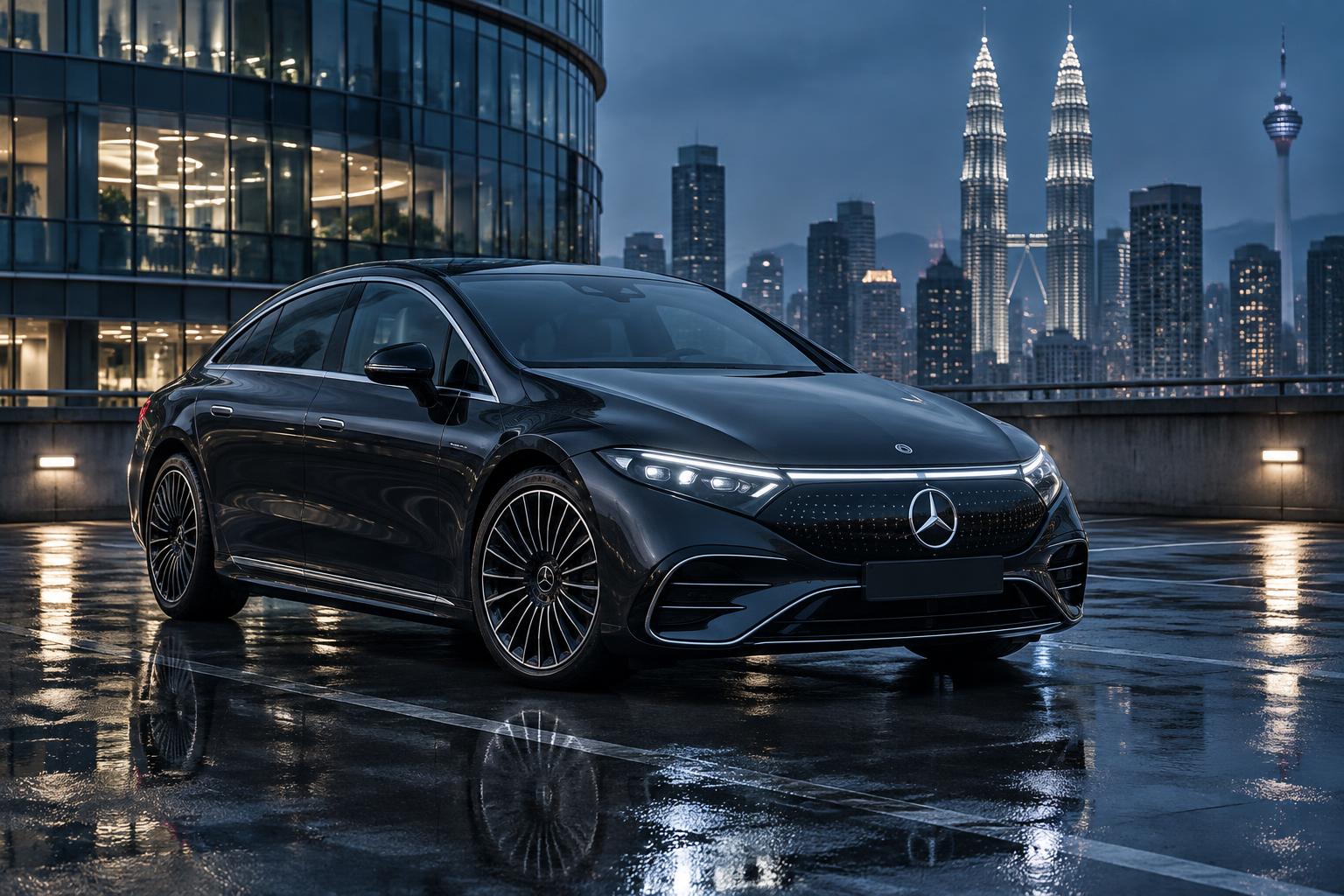
That's exactly why we put electric and hybrid vehicles in our fleet — like the Mercedes-Benz EQS, which remains one of the most impressive cars I've ever driven, electric or not. Guests arrive curious and leave converted, and some of them go on to buy their first EV. I consider that part of our job now.
The future of cars isn't something happening to us. It's something we get to try before it arrives. Take it for a spin.
Frequently asked questions
Quick answers.
How much does it cost to charge an electric car in Malaysia?
Charging at home overnight typically costs a fraction of an equivalent full tank of petrol for the distance covered. Public fast chargers cost more than home charging but are still usually cheaper per kilometre than petrol. Exact figures depend on the car, tariff and charger type.
Where can I charge an electric car in Malaysia?
Fast and normal chargers are now found at shopping malls, hotels, highway rest stops and residential developments, mainly in and around cities like Kuala Lumpur. Several apps show live charger locations, availability and pricing before you travel.
Can I drive an EV from Kuala Lumpur to Penang or Johor?
Yes. Modern EVs handle interstate trips comfortably with a planned charging stop at a highway plaza along the way. Charging during a meal break is the simple routine most EV drivers follow.
Are EVs suitable for Malaysia's rainy weather?
Yes. EVs and their sealed battery systems are engineered and tested for wet and flooded conditions. Rain is not a practical obstacle to driving or charging an EV.
Can I rent an electric or hybrid car from GEARS?
Yes — subject to availability, our fleet includes fully electric and hybrid vehicles such as the Mercedes-Benz EQS, Toyota Corolla Cross HEV and Lexus LM 350h. Reach out on WhatsApp and we'll recommend the right one for your trip.
Final thoughts
The quiet is coming. Embrace it.
The boy who arranged Hot Wheels on a bedroom floor never imagined that one of his favourite questions would become “what do cars sound like when they stop making noise?” The answer, it turns out, is: better than you'd think.
Electric cars aren't the future in Malaysia — they're the present arriving early. Try one, ask your questions, and form your own view from the driver's seat.